mmWave Radar Module Guide: How It Works and Where It Fits
See how mmWave radar modules power privacy-safe smart systems. A practical guide to 24GHz and 60GHz sensors, key specs and OEM selection factors.
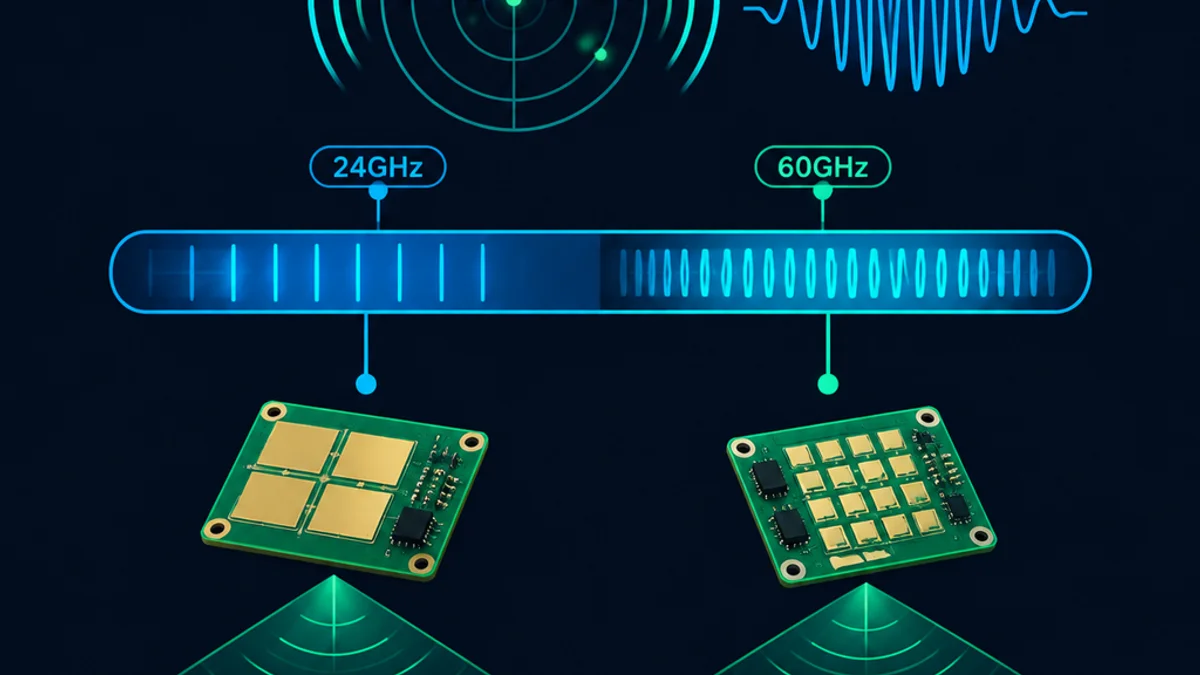
mmWave radar technology is becoming a practical sensing option for products that need accurate detection without relying on cameras. By using high-frequency radio waves, modern radar sensors can detect presence, movement, distance, speed, and sometimes even subtle motion such as breathing. For developers, system integrators, and product teams, the opportunity is clear: build smarter automation, safer mobility, and more privacy-conscious monitoring with compact radar systems.
What makes mmWave radar different from other sensing technologies?
mmWave radar uses millimeter-wave signals to detect objects and motion by analyzing reflections from the surrounding environment. In many systems, a technique called Frequency Modulated Continuous Wave, or FMCW, helps estimate range, velocity, and angle by comparing transmitted signals with reflected ones. Unlike cameras, mmWave radar does not capture images, and unlike simple motion sensors, it can often provide richer information about where a person or object is and how it is moving.
That distinction matters in real applications. A passive infrared sensor may notice that something warm moved across a room, but it may struggle with still presence. A camera may provide visual detail, but it introduces privacy concerns and depends heavily on lighting. A well-selected mmwave radar module can detect motion or presence in darkness, through some materials, and in scenarios where image capture would feel intrusive.

The core principle behind mmWave detection
At a basic level, mmWave radar systems transmit electromagnetic waves at millimeter-wave frequencies and listen for echoes. When those waves bounce off people, vehicles, walls, machinery, or other objects, the returned signal carries information. By processing changes in timing, frequency, and phase, the sensor can infer practical details such as distance, relative speed, and direction.
FMCW radar is especially useful because it continuously changes the frequency of the transmitted signal. The difference between the outgoing and incoming signal helps the system estimate how far away the object is. If the object is moving, Doppler shifts provide velocity information. With multiple antennas, the radar can also estimate angle, enabling more advanced tracking.
This is why mmWave is gaining attention beyond traditional industrial and automotive use. The same underlying physics can support room occupancy detection, gesture interfaces, non-contact health monitoring, drone navigation, robotics, and security applications. The exact performance depends on the radar frequency, antenna design, processing algorithms, installation position, and the environment around the sensor.
24 GHz and 60 GHz each serve different priorities
Choosing between radar frequencies is not just a specification exercise. It affects range, resolution, form factor, power needs, and the kinds of applications a device can support. Two common categories in embedded and IoT sensing are 24 GHz and 60 GHz radar.
A 24 GHz radar sensor is often associated with longer detection range and better penetration through some materials. That can make it useful for broader motion detection, automotive presence detection, and applications where the sensor needs to monitor a wider or more obstructed area. It may be a practical choice when the priority is robust detection rather than fine-grained detail.
A 60 GHz radar sensor typically offers higher resolution and can support more precise sensing. That makes it attractive for close-range applications such as fall detection, breathing monitoring, heartbeat-related micro-motion sensing, gesture detection, and detailed indoor presence awareness. When the use case depends on subtle movement, angular resolution, or compact design, 60 GHz may be the better fit.
A simple way to think about the trade-off:
- Choose 24 GHz when range and penetration are more important. This can suit vehicle cabins, industrial presence zones, or broader movement detection.
- Choose 60 GHz when precision and fine motion matter. This can suit smart bedrooms, healthcare-adjacent monitoring, human-machine interfaces, and compact smart devices.
- Evaluate the full radar system, not only the frequency. Antenna layout, firmware, field of view, filtering, and integration support can matter as much as the band itself.
- Match the sensor to the actual scene. A sensor that works well in an open room may behave differently near metal surfaces, moving fans, glass, pets, or multiple people.
Where are radar sensors creating the most value?
Radar sensors are creating value where products need awareness without demanding constant user interaction. In smart homes, they can help lights, HVAC systems, alarms, and appliances respond to real occupancy instead of basic motion. A room can stay active while someone sits still reading, then power down after the space is genuinely empty.
In healthcare and assisted living environments, mmWave sensing is interesting because it can support non-contact monitoring. Fall detection, bed presence, breathing patterns, and general movement trends may be monitored without placing a wearable on the user or installing cameras in private spaces. These applications require careful validation and responsible design, but the privacy advantage is meaningful.
Automotive radar is another important area. Radar systems can support adaptive cruise control, emergency braking, blind-spot detection, cabin occupancy sensing, and other safety-related features. Even when cameras and lidar are present, radar can add resilience because it works differently and can perform under lighting conditions that challenge vision-based systems.
Industrial automation also benefits from radar’s durability and non-contact nature. Sensors can detect objects, workers, vehicles, or moving equipment in environments where dust, steam, glare, or poor lighting may reduce the effectiveness of optical systems. For robotics and drones, compact radar can help with obstacle awareness, landing support, and navigation in more complex spaces.
Installation decisions shape performance
Even a capable mmwave radar module can underperform if it is installed poorly. Radar is sensitive to placement, angle, field of view, nearby surfaces, and the behavior of the environment. Before tuning software, it is worth getting the physical setup right.
Top-mounted installation is often used for overhead people detection. It can work well when the goal is to monitor a defined zone, such as a desk area, bathroom, doorway, or small room. Overhead placement may reduce occlusion because the sensor looks down into the scene, but coverage depends on mounting height and the sensor’s field of view.
Side-mounted installation is common when detecting movement through a space. Mounting around chest height can help capture body motion, walking direction, and room activity. This approach may be useful for corridors, walls, kiosks, appliances, and interactive displays, but it needs careful aiming to avoid false detections from adjacent zones.
Inclined installation is often used when the target is a bed, chair, or specific resting area. Angling the radar toward the torso can improve the chance of detecting subtle breathing-related movement. For these use cases, small changes in angle can make a large difference, so testing with real users and realistic furniture placement is important.
Practical installation checklist:
- Define the detection zone first. Decide whether the sensor must detect a whole room, a doorway, a bed, a machine area, or a specific seat.
- Avoid unnecessary reflective clutter. Metal surfaces, moving mechanical parts, fans, and nearby vibrating objects can complicate signal interpretation.
- Stabilize power and mounting. Poor power quality or a loose enclosure can introduce noise that looks like movement.
- Test with realistic behavior. Include still sitting, slow walking, sleeping posture, pets, multiple occupants, and normal daily movement.
- Tune thresholds after placement. Software settings should refine a good installation, not compensate for a bad one.

How should teams choose an mmWave radar module?
Teams should choose an mmWave radar module by starting with the use case, not the trend. The best module for fall detection may not be the best option for drone navigation, and a sensor designed for simple presence detection may not provide the data needed for advanced tracking. Clear requirements prevent overbuying, under-specifying, or building around the wrong assumptions.
Begin with the sensing goal. Does the product need binary presence, people counting, gesture recognition, speed estimation, distance measurement, vital-sign-related micro-motion, or object tracking? Each goal requires a different level of resolution, processing, firmware support, and calibration effort.
Next, consider integration. Some modules provide processed outputs, making them easier to connect to microcontrollers, smart home hubs, or IoT gateways. Others expose lower-level radar data that can support customization but require more signal processing knowledge. Developer-friendly documentation, sample code, open-source resources, and configuration tools can make a major difference during prototyping.
Also consider the operating environment. A module intended for a quiet bedroom may need different filtering than one used near machinery. A device installed in a multi-sensor smart building may need strategies to reduce interference. If several radar sensors operate close together, teams should think about placement, timing, shielding, and configuration to reduce unwanted cross-talk.
Integration with IoT and smart environments
The future of mmWave radar will be shaped not only by sensor hardware but by how well radar data connects to wider systems. In a smart home, radar can become an input for lighting, security, climate control, eldercare alerts, and energy management. In commercial buildings, occupancy-aware automation can help meeting rooms, offices, and shared spaces respond more intelligently.
For developers, the integration path usually depends on how much abstraction the project needs. A simple product may only need a presence output sent to a controller. A more advanced system may need coordinates, velocity, target classification, or raw signal features. The more detailed the data, the more important it becomes to manage privacy, processing load, and false positive behavior.
A practical development flow may look like this:
- Prototype with a development board or module that includes examples.
- Validate the sensing concept in the real environment.
- Tune detection zones, sensitivity, and filtering.
- Connect outputs to the target platform or automation system.
- Run long-term tests to observe edge cases, interference, and user behavior.
- Refine the enclosure and mounting before final deployment.
Open-source tools and community examples can speed up experimentation, especially for teams new to radar systems. They should not replace proper validation, but they can help developers understand configuration, data formats, and common design patterns faster.
Challenges that still need careful engineering
mmWave radar is powerful, but it is not magic. Environmental reflections can create confusing returns, especially in small spaces with metal, glass, or moving background objects. Multi-person scenes can be difficult to interpret, and advanced applications such as vital sign monitoring may require careful positioning and signal processing.
Power supply quality is another practical issue. Noise, voltage instability, or poor grounding can reduce reliability, particularly when the radar is embedded in a compact product with wireless radios, motors, displays, or switching power circuits. Mechanical design matters too, because enclosure materials and sensor placement can affect transmission and reception.
Interference between multiple radar sensors can also occur when devices operate near each other. Good system design may include spacing sensors apart, adjusting orientation, selecting appropriate operating modes, or coordinating measurement timing. These details are not glamorous, but they often determine whether a prototype becomes a dependable product.
The future points toward smarter sensing ecosystems
The next stage of mmWave radar technology will likely involve tighter integration with AI, edge computing, and multi-modal sensing. Radar data can be combined with audio, environmental sensors, wearables, cameras, or lidar when the application requires more context. In privacy-sensitive spaces, radar may provide the primary awareness layer while other sensors are used only when necessary.
AI can help classify patterns, reduce false alarms, and adapt to changing environments. For example, a smart building system may learn the difference between a person sitting still, a fan moving, and a pet crossing the floor. A healthcare-oriented device may improve its ability to distinguish normal resting motion from events that require attention.
The strongest future applications will not treat radar as a novelty. They will use it where its strengths are genuinely valuable: privacy-preserving awareness, non-contact detection, operation in darkness, compact integration, and rich motion information. As modules become easier to use and development resources improve, mmWave sensing will become more accessible to product teams beyond specialist radar engineering.
Key takeaways
mmWave radar is moving from specialized sensing into everyday connected products. The technology can help radar sensors detect presence, movement, distance, angle, and subtle motion while avoiding the privacy concerns of image capture. The right choice depends on frequency, module capability, installation method, environment, and integration needs.
For broad detection and longer range, 24 GHz can be a strong fit. For precise indoor monitoring, compact designs, and subtle motion, 60 GHz often offers compelling advantages. The future of radar systems will belong to teams that combine good hardware selection with careful installation, thoughtful software, and realistic testing in the environments where people actually live, work, and move.
Not sure which sensor fits your project?
Talk to our mmWave application engineers for a free consultation.
Specify your hotel project with our engineers
Send your room count, ceiling type, and protocol preference. We will return a sample plan and quote within 24 business hours.
- Move from general guidance into a product or application discussion.
- Use RFQ when pricing, drawings, MOQ, or launch timing needs structure.
- Keep a direct contact path visible for fast clarifications and handoff.